The digital landscape continues to change rapidly in 2026. Customers now discover brands through Google Search, AI-powered search experiences, social media, videos, online reviews, and personalized recommendations. Therefore, businesses need smarter and more adaptable digital marketing strategies to attract attention, build trust, generate leads, and increase sales.
Traditional online marketing methods still have value. However, successful businesses now combine search engine optimization, artificial intelligence, social media, video content, email marketing, first-party data, and conversion optimization. In addition, Google continues to emphasize helpful, reliable, people-first content for both traditional search and newer AI-powered search experiences.
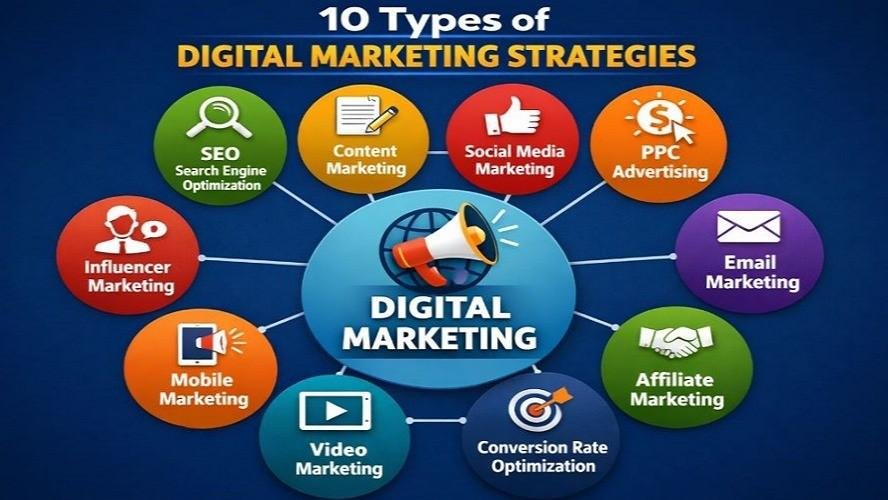
Here are 10 digital marketing strategies that can help businesses build a stronger online presence and achieve sustainable growth in 2026.
1. Build an AI-Ready SEO Strategy
SEO remains one of the most powerful digital marketing strategies in 2026. However, search behavior is becoming more conversational because users increasingly interact with AI-powered search features.
Businesses should create useful content that directly answers customer questions. Instead of focusing only on individual keywords, marketers should cover complete topics, search intent, related questions, and practical solutions.
Moreover, websites should have a clear structure, fast performance, strong internal linking, mobile-friendly design, and properly optimized content. Google states that the same fundamental SEO practices continue to apply to AI Overviews and AI Mode.
2. Create Helpful and Original Content
Content marketing remains at the center of effective digital marketing strategies. However, publishing large amounts of generic content is no longer enough.
In 2026, businesses should focus on original articles, expert insights, case studies, tutorials, comparisons, statistics, customer stories, and practical guides. Content should solve real problems instead of simply filling pages with keywords.
Furthermore, businesses should demonstrate experience and expertise within their industry. Original content can help a brand become more recognizable while also creating opportunities for organic search visibility.
3. Optimize Content for AI Search
AI search optimization is becoming an important part of modern digital marketing strategies. Users increasingly ask detailed questions through AI-powered search experiences, and businesses need content that provides clear, trustworthy answers.
Google’s 2026 guidance emphasizes unique, valuable, non-commodity content rather than artificial “AI hacks.” It also confirms that traditional SEO fundamentals remain relevant for generative AI search.
Therefore, write concise answers, explain concepts clearly, use descriptive headings, include relevant facts, and provide genuinely useful information. Most importantly, create content for people first rather than trying to manipulate search systems.
4. Use Short-Form Video Marketing
Video marketing is another highly effective approach among modern digital marketing strategies. Platforms such as Instagram, YouTube, Facebook, and other video-focused channels allow businesses to communicate with audiences quickly.
Short videos can explain products, demonstrate services, answer frequently asked questions, introduce team members, showcase customer experiences, and share industry tips.
Additionally, businesses can repurpose one long-form video into multiple short videos, social posts, website content, and email campaigns. This approach saves time while increasing content distribution.
5. Strengthen Social Media Marketing
Social media remains essential for building brand awareness and customer relationships. However, successful digital marketing strategies require more than simply posting promotional messages.
Businesses should develop platform-specific content based on audience behavior. For example, educational posts can work well for professional audiences, while entertaining videos and visual content can attract consumers.
Furthermore, businesses should actively respond to comments and messages. Social media is not only a publishing channel; it is also a relationship-building platform.
6. Build a First-Party Data Strategy
Customer data is becoming increasingly important in 2026. Therefore, collecting and managing first-party data should be included in your digital marketing strategies.
Businesses can collect valuable information through website forms, newsletter subscriptions, customer accounts, surveys, purchases, loyalty programs, and direct interactions.
This information helps businesses understand customer preferences and deliver more relevant experiences. It can also support better email campaigns, personalization, audience segmentation, and remarketing.
However, businesses should collect and use customer information responsibly and transparently while following applicable privacy requirements.
7. Use Email Marketing for Customer Retention
Email marketing continues to provide an effective way to maintain direct communication with customers. As a result, it should remain part of your digital marketing strategies in 2026.
Instead of sending the same message to everyone, businesses should segment their audiences. Welcome emails, product recommendations, educational newsletters, abandoned-cart reminders, special offers, and re-engagement campaigns can be tailored to different customer groups.
Moreover, email automation allows businesses to communicate consistently without manually sending every message.
8. Improve Local SEO and Online Reputation
For businesses serving specific cities or regions, local SEO is one of the most practical digital marketing strategies. A strong local presence helps customers find businesses when they search for nearby products and services.
Businesses should maintain accurate business information across relevant platforms, create location-focused content, collect genuine customer reviews, and optimize their websites for local search intent.
Reviews are particularly important because customers often evaluate reputation before making a purchase. Therefore, businesses should consistently deliver quality service and encourage genuine customer feedback.
9. Focus on Conversion Rate Optimization
Getting website visitors is only one part of online growth. Turning those visitors into leads and customers is equally important.
Conversion rate optimization should therefore be included in your digital marketing strategies. Businesses should examine landing pages, forms, calls to action, navigation, product pages, pricing information, and checkout experiences.
For example, a clear headline, strong value proposition, simple form, visible call-to-action button, trust signals, and customer testimonials can improve the user journey.
Furthermore, businesses should test different page elements and use actual performance data instead of relying entirely on assumptions.
10. Measure Results and Continuously Improve
The final strategy is measurement. Without proper tracking, businesses cannot determine which digital marketing strategies generate meaningful results.
Marketers should monitor important metrics such as organic traffic, leads, conversion rates, customer acquisition cost, engagement, email performance, revenue, and return on investment.
Google has also introduced generative AI performance reporting in Search Console, giving some websites additional visibility into how their pages appear within generative AI features.
Therefore, businesses should regularly review performance and adjust their campaigns. A strategy that works today may need refinement tomorrow because customer behavior, platforms, competitors, and search technology continue to evolve.
How These Digital Marketing Strategies Work Together
The strongest results come from combining these digital marketing strategies instead of using them independently.
For example, SEO can bring visitors to a website. High-quality content can educate those visitors. Video can strengthen engagement, while social media can expand reach. Email marketing can nurture leads, and conversion optimization can turn interested visitors into customers.
At the same time, analytics can show which channels perform best. Businesses can then invest more resources in successful activities and improve weaker areas.
Conclusion
The online marketplace is more competitive than ever in 2026. Consequently, businesses need flexible, customer-focused, and measurable digital marketing strategies to remain visible and competitive.
AI-powered search, original content, SEO, video marketing, social media, first-party data, email campaigns, local SEO, conversion optimization, and analytics all play important roles in modern digital growth.
Most importantly, businesses should avoid chasing every new trend without a clear objective. Instead, they should understand their audience, provide genuine value, measure results, and continuously improve.
When implemented consistently, these digital marketing strategies can help businesses attract the right audience, strengthen their online presence, generate qualified leads, and create sustainable growth throughout 2026 and beyond